
The Walls Were Recipes
Part Two of Three
I went in March. We were there during Ramadan. The call to prayer marked the hours five times a day. The country itself was on a different rhythm — slower by daylight, alive after sunset.
Five temples: Karnak. Dendera. Abydos. Edfu. Philae. Each one held chambers where the oils had once been blended. Each one held walls where I imagined the recipes were once inscribed.
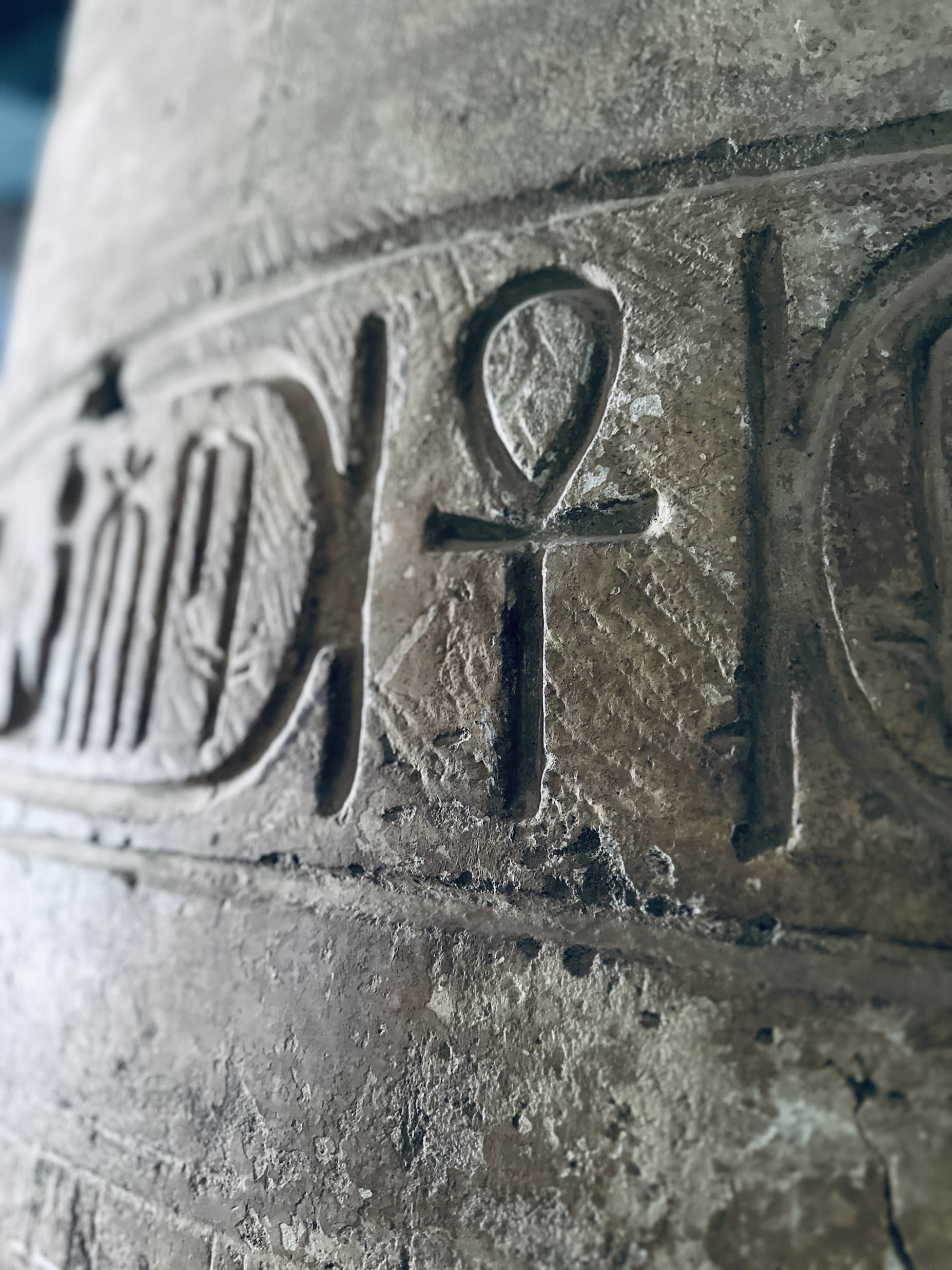
What I had not let myself imagine — until I was standing in front of them — was that some of those recipes are still there. Carved into stone. Legible. Some over two thousand years old.
I started at Karnak.
The largest religious complex of the ancient world. You walk through the Hypostyle Hall under one hundred and thirty-four columns, the central row as tall as a six-story building, every one carved with offering scenes. Priests anointed the daily statue of Amun-Ra here. The incense was burned at appointed hours — frankincense at sunrise, myrrh at noon, kyphi at sunset. The same offerings, the same order, the same prayers, for over a thousand years.
I imagine the smoke had its own permanence — settled into the stone, into the linen of the priests' robes, into the air that visitors carried out into the sun.
Then Dendera.
This was Hathor's temple. The walls hold offering scenes — pharaohs presenting incense, jars of perfume, the kyphi compound burning in long-handled censers. The air would have been warm-amber, resin-thick, layered with myrrh and sandalwood.
I stood in one of the chambers a long time. This had been a working room for centuries. Materials weighed, ground, aged. The same gestures, daily, by hands trained by the hands before them.
The closest I make to that atmosphere is Santal Amber — sandalwood and musk at the base, amber and cedar at the heart, a triad of spice up top. I cannot recreate Dendera. Nothing I have can. But this is what I reach for when I want a room to feel — even briefly — like a room where something is being honored.
Abydos was different.
Quieter. Fewer travelers. The temple of Seti I, dedicated to Osiris — the god of resurrection, of the long passage. The reliefs are some of the most refined in all of Egypt. The pigment is still on some of them. Faint blue. Faint ochre. The faces of gods almost smiling.
The air at Abydos is cooler. The temple sits at the edge of the desert. You feel something there that you do not feel at the more famous sites. Something about ancestors. Something about what was meant to be remembered.
Then Edfu.
If you only see one perfume room in Egypt, this is the one. Edfu has a small chamber sometimes called the Laboratory — a stone room off the great hall — where two recipes for kyphi are inscribed, in hieroglyphics, directly on the walls.
The recipes name the ingredients. The recipes name the proportions. The recipes name the order in which things must be added — and how long the compound must age.
These are working documents. Instructions written for the next generation of priests, in case the formula was forgotten. They are the most detailed perfume recipes that have come down to us from antiquity, preserved on the walls so the practice could not be lost.
I stood in that room a long time. What we do at the Fragrance Bar descends from this — not in lineage of priesthood, but in the lineage of recording what scent does and how it is made.
And then Philae.
The temple is on an island in the Nile, just south of Aswan. You take a boat to reach it. The whole structure was relocated stone by stone in the nineteen-sixties and seventies, after the construction of the High Dam — moved to higher ground so it would not be lost to the rising water. One of the most extraordinary acts of preservation in the history of archaeology.
It is dedicated to Isis. The walls there hold their own kyphi inscriptions — carved during the Ptolemaic period, the last formal use of the temple before its closure in the sixth century after Christ.
I went there last. There is more I will tell you. Not in this letter. In the third one.
What stays with me, after all five — what I keep returning to — is how seriously they took it. The rooms were specific. The recipes were preserved. The materials were ranked, weighed, ordered, aged. The hours of release were marked.
Five thousand years later, in a small shop in a historic town on the Northern California coast, I keep an open space — fragrance oils (some from Egypt), pipettes, scent strips, a working table where visitors can sit. There are two ways into it.
The DIY Fragrance Bar is open whenever the shop is. You walk in, you sit down, you find what your nose recognizes.
The Scent Blending Experience is by appointment, with me, for about an hour. A blending session toward a fragrance that belongs only to you.
It is what I call L'Atelier. Smaller than a temple. The same care for materials. The same attention to the hours. Part of the same lineage.
In gratitude,
Stephanie
This is the second of three letters on where fragrance began. The third arrives Thursday, June 18 — the most personal of the three. What I brought back from those walls.
The recipes have changed. The hands have changed. The thread has not broken.
If you missed the first letter, it's on the journal.
Aprés Fragrance · Duncans Mills Candle Co.
Historic Duncans Mills, California